“We Stand Together Around the Last Blast Furnace” is an initiative to celebrate, safeguard, and breathe new life into Reșița’s last blast furnace—one of the most imposing industrial heritage assets in the city and a symbol of over 250 years of steelmaking history. The goal of the project is to involve the local community, along with local and national institutional actors, in the revitalisation of the blast furnace—a process that can only take shape through the prior recovery of local history and memory.
Together with experts from the community, academia, and civil society, we aim to create a participatory framework that enables us to envision a functional and sustainable conversion of the furnace. This includes promoting it as a valuable piece of industrial heritage to diverse audiences and debating scenarios for public-private co-governance that would steward Reșița’s industrial heritage, with a particular focus on the furnace.
What about the Furnace?
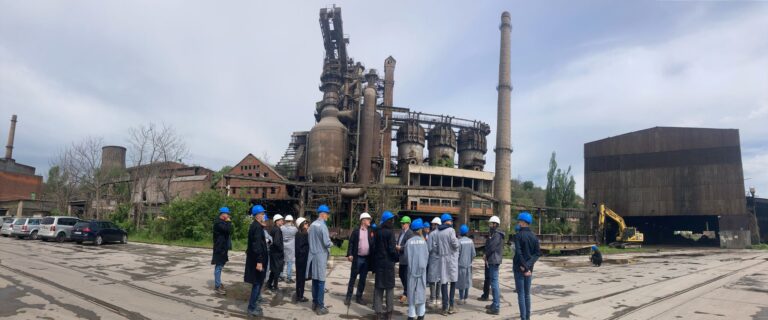
Blast Furnace No. 2 in Reșița is one of the most remarkable symbols of industrial heritage in Romania’s Banatul Montan region, and it is among the last blast furnaces in the country to still be preserved. Located on the site of the former Reșița Steel Works (CSR), the furnace is part of an industrial complex with roots going back to 1771, when the first furnaces and forges were inaugurated in Reșița under the administration of the Habsburg Empire. At the peak of the plant’s activity, the furnace was an integral part of a complex steel industry that included coking plants, steelworks, rolling mills, and foundries, functioning alongside the heavy machinery and equipment plant.
Blast Furnace No. 2 was decommissioned in 1992 and remains standing thanks to its symbolic value for the city’s industrial identity and urban landscape. In the 2000s, it narrowly escaped being scrapped for metal—a fate that its neighbor, Blast Furnace No. 1, could not avoid. The concerted efforts of the last generation of employees of the steel plant, a few industrial heritage enthusiasts, and individuals in key institutions made its classification as a historical monument possible. Although the furnace is a key asset for preserving industrial memory and holds visitation potential, its physical condition continues to visibly deteriorate.
Why do we stand together around the Furnace?
We are coming together for this complex and promising process to see the furnace restored and repurposed for public use. It’s a long journey, but we’re taking the first step alongside the Reșița Municipality, the community, civil society, and specialists from related academic fields. The project’s core components address the need for transparency and openness in the processes required to safeguard and repurpose the furnace:
━ Documentation: We are conducting a historical-technical study on the blast furnace site, involving a team of architects specialized in industrial heritage, collaborators experienced in the digitization and interpretation of archive photographs, and engineers specialized in topographic surveying, photogrammetry, and 3D laser scanning. In collaboration with a group of oral historians—including journalists and anthropologists—we are documenting Reșița’s transformations and the lives shaped by these transformations, creating a living archive of the community’s experiences. Fragments of the documentation material will be presented in exhibitions accessible to the general public both offline as through the Virtual Museum of Reșița. More details >>> HERE.
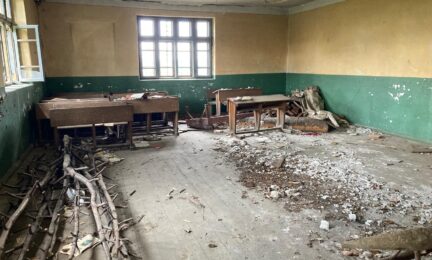
━ Engagement and consultation with diverse audiences: At the beginning of August, we are organizing “Awakening the Furnace!”, a public event combining the Street Delivery and UrbanEye Film Festival formats. It will include activities for discovery, awareness, and participatory ideation—tours, public forums, workshops and artistic interventions, screenings, and more. This second edition will take place August 1–3 on Furnace Street and at Pittner School, gathering different stakeholders in the city’s life—residents, urbanists, architects, cultural figures, historians, etc.—to contribute ideas and suggestions for the furnace’s revitalization vision.
━ Sustainability vision: This includes public debates with institutional stakeholders, study visits, and access to foreign expertise (we’ll visit the Dolni Vitkovice industrial area in the Moravia-Silesia region of the Czech Republic, and the Ignacy Historic Mine—one of the oldest coal mines in Upper Silesia, Southwest Poland). These activities will culminate in a position paper with scenarios for sustainable governance of the revitalization process focused on the city’s industrial heritage, centered on the furnace.
Complementing the event, at the beginning of August, the interdisciplinary summer school on industrial heritage—Reșița Industrial Heritage Lab—will also take place, organized by MKBT and the Non-Formal Spatial Planning Workshop under the umbrella of Reșița 250 Lab. More details >>> HERE. Student proposals will be presented during the public Street Delivery event. This project is supported by the Romanian Order of Architects, from the Architectural Stamp Duty, The King’s Foundation, and Reșița City Hall.
These activities are coordinated by MKBT, with the involvement and support of Reșița City Hall, and local partners Muzeul Cineastului Amator and the Banatul Montan Community Foundation, as part of the project “We Stand Together Around the Last Blast Furnace.” The project is co-financed by The Administration of the National Cultural Fund and is organized under the Reșița 250 Lab umbrella—an urban innovation lab initiated in 2023 by MKBT, acting as a catalyst for an ecosystem of co-creation, testing, and implementation of urban regeneration actions in Reșița.
News and updates about this project will be shared by the organizers at www.muzeulvirtualresita.ro and www.mkbt.ro.