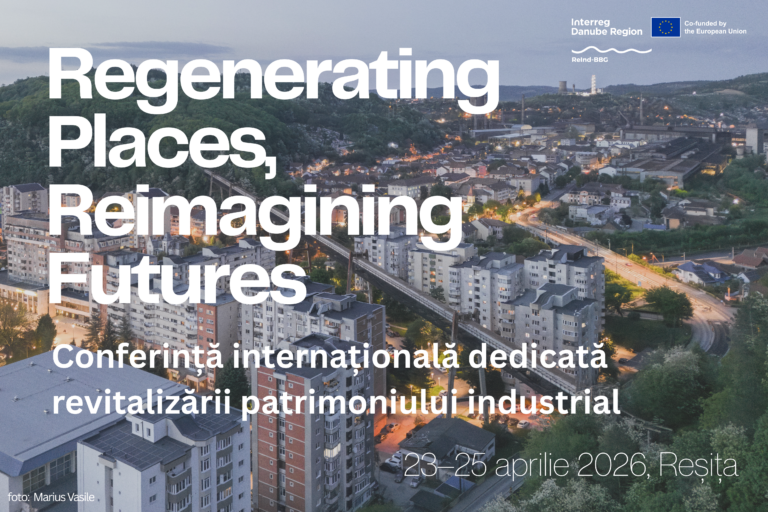
International Conference on Investing in Industrial Heritage Revitalization
When: April, 23 – 25
Where: Multifunctional Center Reșița
Language: English | Live translation into Romanian will be available
Registration is possible → HERE
For resources (agenda and bios for speakers), scroll down to the end of this text.
Across the Danube region, dozens of small and medium-sized towns face a shared challenge: what to do with the vast industrial sites left behind by the late 20th-century economic shifts. Former factories, mines, and steelworks that once defined the identity and prosperity of entire communities now sit abandoned or underused. How can we breathe new life into these spaces to create jobs and creative hubs, while strengthening local communities and honoring the heritage within their walls?
This international conference brings together local authorities, urban regeneration experts, researchers, investors, and policymakers from Central and Eastern Europe. Together, we will exchange experiences, debate solutions, and forge new partnerships to tackle this common goal. With participants from at least six countries, the event will showcase transformation models from Poland, Slovenia, Romania, and beyond. Our goal is to spark dialogue and strengthen ties between Danube towns, building resilience and promoting sustainable development through industrial heritage. We believe that the leadership and public service practices emerging from these Central and Eastern Europe towns are vital and relevant to an international audience.
The conference is organized within the framework of the EU-funded ReInd-BBG and NONA projects (Interreg Danube Region Programme). It is hosted by the Reșița City Hall, in partnership with MKBT: Make Better, the Iskriva Institute (Slovenia), and the ITI Banatul Montan Intercommunity Development Association.
As the oldest steelmaking center in Romania and one of the oldest in Central and Eastern Europe, Reșița is the perfect setting and host for this conversation. Over the last decade, the city has turned its industrial legacy into an engine for renewal through strategic investments and a community committed to reimagining its future. In 2026, the city celebrates two major milestones: 250 years since its factories earned the right to brand their own products, and its centenary as an official city, a symbolic moment to reflect on industrial identity and the paths it opens for the future.
What we are aiming
>>> Promoting discussions and the exchange of innovative policies regarding the most urgent urban regeneration challenges faced by small and medium-sized municipalities in areas affected by restructuring and demographic changes. Particular emphasis will be placed on industrial heritage revitalization strategies.
>>> Facilitating the exchange of experiences and the dissemination of results from Interreg Danube Region projects that have been recently completed or are nearing completion, as well as promoting them;
>>> Promoting cross-border partnerships and action networks between local authorities and other interested stakeholders from countries across the Danube region;
>>> Exporing financing strategies for replicating and scaling up pilot projects tested within the Interreg Danube Region framework, such as NEB framework funding, Integrated Territorial Investments (ITI), Mission 100, and the Just Transition Mechanism;
>>> Presenting the progress and results of the Revitalization through Culture Strategy, which is currently under development. Additionally, the event will serve as a meeting point for the EUSDR Priority Area 3 Steering Committee – Culture and Tourism.
More details about the conference, as well as the schedule (including regular updates), >>> HERE <<<
Detailed conference agenda
Simplified conference agenda
Speakers’s bios
—
The event is organized as part of the cooperation between the Interreg Danube Region projects ReInd-BBG: Reindustrialisation following the Brownfield is better than Greenfield Principle and NONA – New Governance for New Spaces, supported by the Interreg Danube Region Programme and co-funded by the European Union.